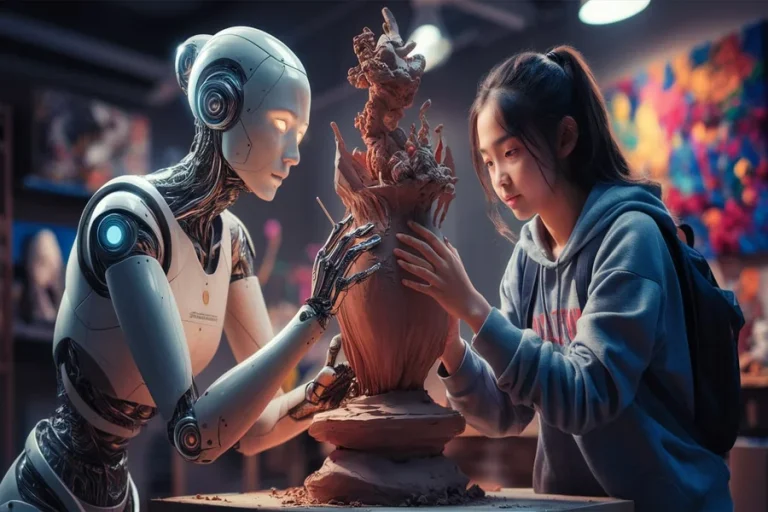
Production of video content has emerged as a critical element of digital communication in a variety of business, educational, product demonstration, and personal project contexts, used to promote marketing campaigns on social media or simply to showcase new products and services. Besides business, educational, product demonstration, and personal projects that use video content to help promote marketing campaigns on social media, it has become a very important activity in digital communication. Creating a fancy video typically will need a couple of special skills such as video editing, sound enhancement, video narration, visual effects, and video script writing. AI will revolutionize many editing jobs in the future and make them easier and faster. From editing raw footage to producing engaging visuals and story outlines, AI-powered tools can assist film producers in many ways throughout their projects. These AI tools can aid in film production in numerous ways, from editing raw footage to generating captivating visuals and story outlines, throughout their projects. This is one way that creators can focus more on the idea and concept of the film and less on the repetitive technical work.
The Growing Role of AI in Video Creation
The introduction of artificial intelligence has opened the door to a new method in video creation, one that enables producers to manage tech-heavy and time-consuming editing jobs with a level of automation they hadn’t previously realized. Users can increasingly use the intelligent software to select the relevant content from clips, transcribe speech, summarize content and pinpoint the key points.
This does not imply that creativity is a passing fancy for human beings. Instead, AI is designed to be a tool that alleviates the necessity of doing repetitive tasks when creating a video. Once the creative is established, the creator is free to concentrate on storytelling order, pacing, visual direction, and the overall grouping of the message to the viewer.
Making Editing More Accessible
Video editing can be quite a complicated and difficult process to accomplish, and it might require complicated software that can be difficult to use. It takes time for them to learn how to get professional-looking results; they may not know the steps and settings for various exports, such as timelines, transitions, audio tracks, effects, color adjustments, or other settings.
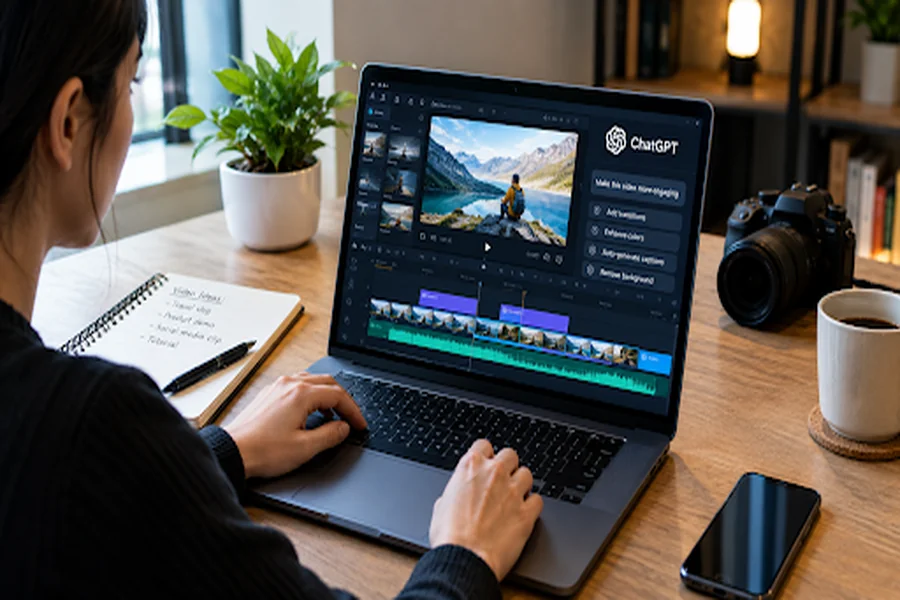
AI-powered editing platforms are helping simplify these processes. A ChatGPT video editing tool can help creators leverage AI to produce video and discover alternative processes that more quickly bring ideas to a visual representation. Users will not need to perform each and every editing task manually, but can work with intelligent features that will help guide portions of the creative workflow.
This may be very helpful for people who make video content or for small business owners, students, and independent creators who don’t have their own video production staff.
AI-Assisted Scripting and Planning
Often, the first clip is not added to a timeline during the editing process. With effective final production, they may have better structure and a good script. AI can help with brainstorming ideas, structuring your thoughts, creating outlines, and tailoring the content to fit various audiences.
For example, someone might want to create a quick how-to video or tutorial on a subject, and AI can help them simplify and organize the content. A marketer could employ the same technology to create multiple versions of a campaign. The ability to do these things can save on preparation time without sacrificing control over the intended message.
Best practices involve using AI support along with people’s expertise. While AI can offer a range of potential ideas, it is up to the creator to determine what is suitable, applicable, and correct.
Faster Captions and Audio Processing
The captions are now an essential aspect of online video since many users watch video without sound. The production of subtitles can be done on a case-by-case basis, which may be quite time-consuming for longer videos.
Automatic speech-to-text transcription and its synchronization with video using AI can assist in ensuring captions are aligned with speech. Machine speech-to-text recognition can automatically transcribe conversations for archiving and help match the speech to the captions. In some systems, they can also recognize distinct speech portions, which aids with reviewing and editing the created text.
Another way AI can help with time efficiency in audio is in audio processing. Not just that, but audio processing is also another area where AI can help save time. Features such as Background Noise Reduction, Voice Enhancement, and Audio Level Detection can be helpful in enhancing clarity, and these can be done with basic technical know-how. These features are especially helpful when creators are shooting outside of the ideal or pretty studio.
Personalization and Short-Form Content
Short video has emerged to meet users’ demand for fast editing speed. Creators will be required to modify decisions to the same work for various platforms, audiences, and formats.
AI can be used for content prioritization for longer content and to help produce shorter versions. It can also accommodate changes in aspect ratio, captions, and visual timing, among other dimensions that might be necessary for various publishing environments.
Another possible benefit is the customization aspect. Customizing the content so that it can speak to different demographics relates to its message, length of presentation, and accompanying images. This enables business owners and content developers to implement various strategies instead of generating new videos.
Human Creativity Still Matters
Despite advancements made in artificial intelligence, the latter still cannot create effective videos as humans do. However, AI tools can give recommendations when creating a successful opening or working through edit proposals but cannot grasp the heterogeneity of audiences, brand messages, and cultural nuances.
It is important for creators to examine results generated by AI tools and make sure they meet their requirements. Captions may still be wrong, pictures may be inappropriate, either the transitions between parts might happen abruptly or in a manner that doesn’t really convey the ideas, and incorrect information may also be included. The selection of a human element guarantees that the quality standards of the videos are adhered to and that the message is delivered correctly. AI can only be used to assist in the decision-making process.
The Future of AI Video Editing
In the future, AI tools for video creation will likely become more vital to standard creative processes. With the advancement of these technologies, editorial solutions could increasingly offer more advanced guidance on story structure, scene arrangement, sound, captions, visual effects, and content adaptation.
The speed of editing is not necessarily the best thing for creators. Perhaps it’s easier to try out new concepts. This is because the additional time that can be harnessed when a product is produced repeatedly can be used to experiment with new ideas, improve story development, and start to put out content more regularly.
So the future for video editing will be driven by intelligent automation and human creativity. AI can take care of lots of technical and repetitive activities, but people are still required to provide concepts, judgment, authenticity, and final creative direction.