
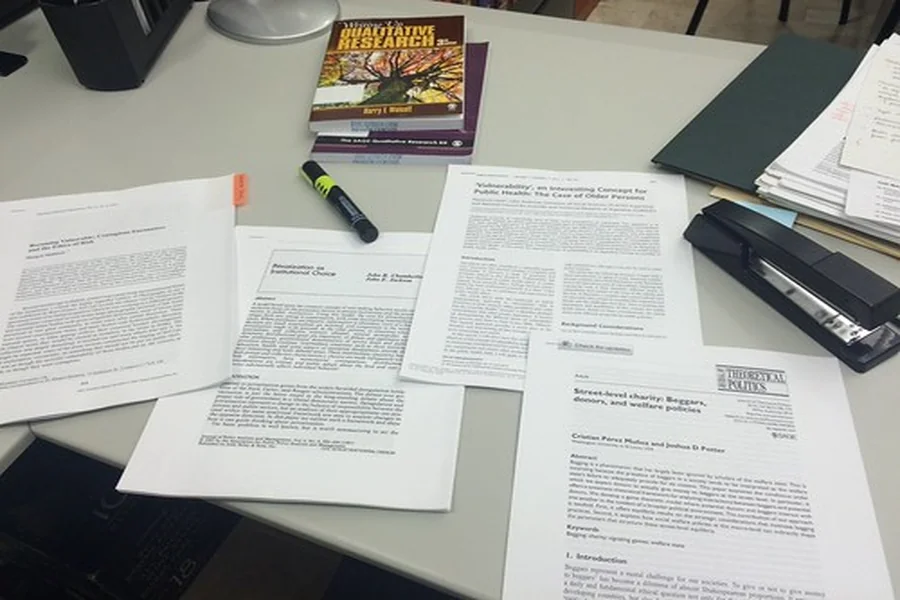
When you are writing a comprehensive literature review for a university assignment, you follow a series of steps starting from grouping your sources by core themes. You have to critically evaluate where the researchers and scholars agree and disagree. Similarly, you have to utilise this comparative analysis to identify critical gaps or unanswered questions that are worth investigating. That is the primary objective of the entire task. Many students find this process challenging and look for reliable assignment help rather than spending some time to understand the task and work on it themselves. To help students effectively structure the literature review for the assignments, we are providing a comprehensive guide which includes a practical word budget breakdown, a systematic workflow, and an effective academic layout that will ensure that you are all ready to score in the highest marking bands.
- Literature review assignment vs dissertation chapter: what changes
- A word budget for a 1,500-, 2,000- or 3,000-word literature review
- How to write a literature review for an assignment in five steps
- The synthesis matrix: a one-page method that turns summaries into a review
- Literature review structure: thematic, chronological or methodological?
- Common mistakes in a literature review assignment
- If this is the dissertation chapter, not the assignment
- Frequently asked questions
- How many sources should a literature review assignment have?
- What is the difference between a literature review and an annotated bibliography?
- Can I include sources that disagree with my position?
- Conclusion
Literature review assignment vs dissertation chapter: what changes
Most guides online describe the dissertation literature review: an exhaustive survey of a field, often 8,000 words or more, that justifies a research design. A literature review set as coursework is a different exercise. It is shorter and typically constrained to a limit of 1,500 to 3,000 words. It is usually on a theme your lecturer has set. You are not required to provide exhaustive domain coverage, as your marker will evaluate on the basis of how you connected the past evidence in your literature review, not how many papers or sources you analysed.
That means you can leave out three things the dissertation version needs. You do not need to justify a methodology. You do not need to prove you covered everything published on the topic. And you do not need a conceptual framework diagram. Instead of comparing sources directly, you have to evaluate their strengths and weaknesses to conclude what the literature shows and where the knowledge gap lies worth exploring.
A word budget for a 1,500-, 2,000- or 3,000-word literature review
Students lose marks on this assignment for one recurring reason: the introduction runs long, the body becomes a list of summaries, and the conclusion is two sentences written at midnight. To prevent this, it is suggested to make a word budget. You can use the word allocations below as a starting point and adjust them to your specific brief.
| Target Length | Introduction (~10%) | Main Thematic Body (~70%) | Gaps & Implications | Conclusion (~5–7%) |
| 1,500 words | 150 words | 1,050 words
(3 sections × 350) |
200 words | 100 words |
| 2,000 words | 200 words | 1,400 words
(3–4 sections) |
250 words | 150 words |
| 3,000 words | 250 words | 2,150 words
(4–5 sections) |
400 words | 200 words |
Remember that: The main thematic body consistently claims roughly 70% of the total budget, while the gaps and implications section should never go below 200 words. This is the part where the markers look for critical analysis.
How to write a literature review for an assignment in five steps
- Define the scope from the brief. Write down the theme, the date range and the type of source the brief allows (peer-reviewed journal articles, reports, books). If the brief specifies several sources, that number is your target, not a minimum to exceed.
- Search systematically, then stop. Use your library’s academic databases with two or three keyword combinations, and apply inclusion criteria before you read: date, relevance to the theme, and source type. For a 2,000-word review, eight to twelve sources is a workable number. More than that and you will summarise instead of synthesise.
- Read for position, not for content. For each source, record its main claim, its evidence, its method and its limitation in a sentence each. You are looking for where the source stands on the theme, because your review is built from positions, not from summaries.
- Build a synthesis matrix. This is the step most students skip, and it is described in full below. It turns a pile of notes into a set of themes with sources attached.
- Write theme by theme, ending with the gap. Each thematic section opens with a topic sentence that states what the sources collectively show, then compares them, then evaluates. The final section names what the literature has not answered and why it matters.
The synthesis matrix: a one-page method that turns summaries into a review
A synthesis matrix is kind of an essential grid that can be constructed either within a spreadsheet or manually on a sheet of paper. Now, what it does is provide an organised, structured template to collate the sources needed to incorporate in the literature review. Along the vertical left-hand axis, you can list all selected academic sources individually. Across the horizontal top axis, it is suggested to delineate three to five core analytical themes identified during the preliminary reading phase; for instance, “definition of the problem,” “underlying causes,” “methodological interventions,” and “evaluative measurement,” or whatever your assignment is about. Within each intersecting grid cell, a precise single-line summary should be articulated, specifying what that particular source asserts regarding that specific theme. If a source does not engage with a given theme, explicitly mark the cell as “not addressed” to maintain analytical clarity.
Once the matrix is fully populated, you can transition from row-by-row reading to column-by-column thematic analysis. Each vertical column directly corresponds to a designated thematic section of your literature review. Reading down a column reveals instantly which scholars align in agreement, which present conflicting findings, and which remain silent on the topic. A column containing uniform consensus across all entries yields a concise descriptive background section. Conversely, a column characterised by contradictory findings, competing methodologies, or theoretical incompatibility forms the foundation of your critical evaluation. It provides the exact approach that can get you the highest marks.
For the best results, try to weave together ideas in every paragraph rather than treating sources separately. The main aim should be to bring at least two authors into conversation, whether they’re debating a point or backing each other up. Do not just stick to one source per paragraph, as it will read more like a basic summary. Conversely, putting sources side-by-side to show where they agree or diverge demonstrates real insight and critical thinking.
Literature review structure: thematic, chronological or methodological?
In thematic structure, each section covers one idea across all the sources. It suits almost every assignment-length review and is what the synthesis matrix produces naturally.
Chronological structure works only when the development of the field over time is the point of the brief.
Methodological structure is useful when you are grouping by how the published reports gathered evidence. The biological science and social science reviews utilise this structure where the debate is about method.
Whichever you choose, every section needs the same three moves in order: a topic sentence that states the collective finding, a comparison of the sources, and an evaluation of their strength.
Always signpost the transitions between sections so the marker can follow your argument without re-reading.
Common mistakes in a literature review assignment
- Constructing an annotated bibliography rather than a review. A literature review cannot simply consist of sequential paragraphs for each source. If sub-headings are based on author names, reorganise the content topically.
- Over-relying on direct quotes rather than synthesis. Maintain your own academic voice throughout, referencing source material appropriately. Limit direct quotations to specific key terms or explicit definitions.
- Failing to offer critical appraisal. Stating that “Smith (2021) identified X” merely reports details. Critical analysis requires context, such as noting that “Smith (2021) identified X, though limited by sample size, whereas Jones (2023) observed contrasting results across a broader cohort“.
- Misidentifying a genuine research gap. Vague statements like “further research is required” do not constitute a finding. Clearly define the specific unaddressed inquiry within the literature and explain the significance of resolving it.
- Inconsistent referencing styles. Adhere strictly to a single referencing convention (such as Harvard) and cross-check all in-text citations with the reference list before submission.
If this is the dissertation chapter, not the assignment
If you are using this guide to write a full dissertation chapter instead of a shorter assignment, the core approach is the same, though you’ll need to layer in three extra components. You will need to explain your search strategy in more detail, draw a clear line between the literature gaps you’ve identified and your own research questions, and outline the conceptual or theoretical framework that your methodology chapter will later build upon.
While it can be helpful to look at full-length examples available from Dissertation Writing Services to see how this synthesis method holds up over 8,000 words, remember to use them only as a way to check your structure. They are there to help you stay on the right track, not as a shortcut to bypass your own research and analysis.
Frequently asked questions
How many sources should a literature review assignment have?
As many as the brief specifies. If it does not say, plan for roughly one source per 200 words of body text, so eight to twelve for a 2,000-word review. Quality and relevance count for more than volume; two well-compared sources earn more than five summarised ones.
What is the difference between a literature review and an annotated bibliography?
An annotated bibliography treats each source separately: citation, summary, evaluation, next source. A literature review organises sources by theme and compares them with each other. If your draft could be reordered without changing the argument, it is an annotated bibliography.
Can I include sources that disagree with my position?
You must. A review that only cites supporting sources reads as one-sided and loses critical-evaluation marks. Disagreement between sources is the raw material of synthesis, and explaining why they disagree is where the highest bands are earned.
Conclusion
Mastering the literature review assignment is less about finding the perfect source and more about demonstrating how well you can synthesise existing research. Success relies on three foundational habits: planning your word budget before writing, constructing a synthesis matrix to map your themes, and ensuring every paragraph engages multiple perspectives. By keeping your review thematic and prioritising critical evaluation over simple reporting, you transform a potentially daunting task into a coherent argument. While some students look for Assignment Writing Services to better understand these structural demands, do not rely on them blindly; always ensure you learn the material yourself so you can identify potential errors, as even these services are not 100% correct.