- Key Takeaways
- The Four Main Quality Factors
- Why Cut Often Matters Most
- How Diamond Reports Help Shoppers Compare Stones
- Lab-Grown Diamond Grading Changes
- How Shape Affects Appearance
- Choosing Color and Clarity for Real-Life Wear
- Durability and Daily Wear
- A Simple Diamond Shopping Checklist
- Common Questions About Lab-Grown Diamond Quality
- Are lab-grown diamonds graded like mined diamonds?
- Does a higher grade always mean a better-looking diamond?
- Is cut more important than carat weight?
- How can buyers judge a diamond online?
- Final Thoughts
Key Takeaways
- Consider cut, color, clarity, carat weight, shape, and setting together rather than focusing on one grade.
- Prioritize cut and proportions because they can strongly affect brightness and sparkle.
- Verify the grading report, report number, measurements, shape, and carat weight before purchasing.
- Compare diamonds using clear images or videos and realistic viewing conditions.
- Choose color and clarity based on visible appearance, setting, and personal preferences.
- Consider durability and select a setting that suits the diamond’s shape and everyday use.
- Compare return policies, warranties, treatments, and seller information before buying.
- A higher grade does not automatically mean a better-looking diamond.
A lab-grown diamond can be an excellent choice when it looks beautiful, suits the wearer’s lifestyle, and comes with clear documentation. Carat weight matters, but it does not tell the whole story. Cut, proportions, color, clarity, shape, and setting all influence how a diamond looks in hand. Before comparing listings, it helps to find out how lab-grown diamonds created and understand what the quality details on a listing actually mean. A thoughtful comparison can help shoppers avoid paying extra for grades that may not make a visible difference in everyday wear.
The Four Main Quality Factors
The familiar four Cs are color, clarity, cut, and carat weight. They are useful comparison tools, but they should be considered together rather than treated as a scorecard where every category must be as high as possible.
- Color describes how colorless or warm a diamond appears.
- Clarity describes internal features and surface characteristics.
- Cut covers how a diamond’s facets, proportions, symmetry, and polish work together.
- Carat weight measures weight, not necessarily visible face-up size.
Two diamonds with the same carat weight can look surprisingly different. One may appear broader from the top, while another may carry more of its weight below the girdle. A balanced combination of grades often provides more visual value than prioritizing carat weight alone.
Why Cut Often Matters Most
Cut has a major effect on brightness, contrast, and sparkle. When facets are well aligned and proportions work together, light can return to the viewer in a lively pattern. Poor proportions, weak symmetry, or uneven polishing can make a diamond look less bright even when its color and clarity grades are strong. Research into diamond cut quality and visual appearance also shows why a single number cannot capture every aspect of beauty. Movement, contrast patterns, lighting, and personal preference all shape what a viewer sees. For example, a well-cut oval may look crisp and bright across its center, while a larger oval may show a noticeable dark area or uneven reflections. Review clear video whenever possible, and compare diamonds side by side rather than relying on a grading label alone.
How Diamond Reports Help Shoppers Compare Stones
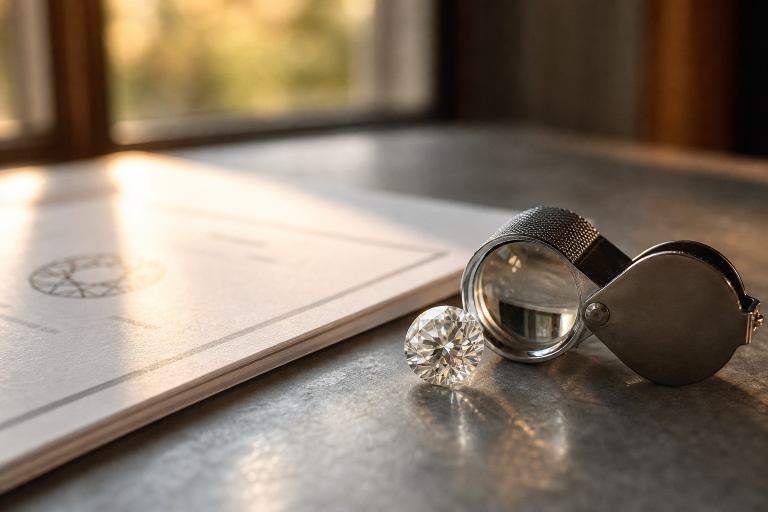
A gemological report gives buyers a consistent record of a diamond’s measurements, weight, shape, color, clarity, finish details, and laboratory-grown origin. It also provides a report number that can be checked with the issuing laboratory. A report is valuable, but it does not replace viewing the actual stone. Confirm that the report number, measurements, carat weight, and shape match the listing. Then inspect images or videos for transparency, symmetry, dark areas, and the overall face-up appearance.
Lab-Grown Diamond Grading Changes
Report formats and language can differ among laboratories, so shoppers should read the complete document rather than comparing only the headline grade. A newer format does not automatically make a diamond better or worse.
One important change occurred on October 1, 2025, when GIA began using “Premium” and “Standard” descriptive assessments for qualifying D-to-Z laboratory-grown diamonds instead of its natural-diamond nomenclature. This means comparisons between reports require extra care, especially when one stone has a traditional color and clarity grade while another uses descriptive terminology.
How Shape Affects Appearance
Shape changes both sparkle style and perceived size. Round diamonds are known for a balanced, brilliant look. Ovals, pears, and marquise diamonds can create a longer outline across the finger. Cushions offer softer corners, while emerald cuts emphasize broad flashes of light and make visible clarity more important. Radiant cuts combine a square or rectangular outline with a more glittering faceting style. Fancy shapes are not all evaluated using the same cut-grade approach as round brilliants. Focus on symmetry, length-to-width ratio, even facet patterning, and whether the diamond looks appealing in real viewing conditions.
Choosing Color and Clarity for Real-Life Wear
Color can look different in daylight, office lighting, and warmer indoor light. The setting also influences perception. Yellow or rose gold may make a slightly warmer diamond appear harmonious, while platinum and white gold can emphasize a cooler look. For clarity, the practical goal is often an eye-clean diamond, meaning inclusions are not readily visible without magnification at normal viewing distance. Move to a higher clarity grade when a feature is noticeable, affects transparency, or distracts from the overall appearance.
- Choose a preferred shape and size range.
- Compare several diamonds with similar measurements.
- Review images or videos under more than one lighting condition.
- Increase clarity only when visible characteristics justify it.
- Consider the metal color before deciding on the color grade.
Durability and Daily Wear
Diamond is widely recognized as the hardest natural material on the Mohs scale, but hardness does not mean a ring is maintenance-free. A diamond can still chip from a sharp impact, and prongs or bands can wear over time.
Bezel settings can offer substantial edge protection, while prong settings expose more of the diamond to view. Pear and marquise shapes have pointed ends that benefit from protective prongs. Remove rings for heavy work, impact sports, and harsh cleaning tasks, then have loose stones and worn prongs checked promptly.
A Simple Diamond Shopping Checklist
- Confirm the shape, measurements, and carat weight.
- Check the report issuer and verify the report number.
- Review cut, polish, and symmetry details.
- Watch a clear diamond video when available.
- Look for dark centers, cloudy areas, or uneven reflections.
- Compare several diamonds in a similar size range.
- Read return, resizing, repair, and warranty policies.
- Ask whether any treatments are disclosed.
- Choose a setting suited to the stone’s shape and daily wear.
Common Questions About Lab-Grown Diamond Quality
Are lab-grown diamonds graded like mined diamonds?
That depends on the laboratory and report type. Some reports use traditional grading terminology, while others use descriptive assessment systems. Always review the specific report.
Does a higher grade always mean a better-looking diamond?
Not necessarily. Grades are useful, but cut quality, proportions, video, and visible light performance can make a meaningful difference.
Is cut more important than carat weight?
Both matter, but cut often has a stronger effect on brightness and sparkle. A slightly smaller, well-cut diamond may look more lively than a larger stone with weaker light performance.
How can buyers judge a diamond online?
Use the report to confirm the listing, review the face-up and side-view videos, compare measurements, and examine the stone under multiple lighting conditions when available.
Final Thoughts
A worthwhile lab-grown diamond is not defined by one impressive number or a single grading characteristic. The best choice brings together an appealing cut, a suitable shape, a sensible color and clarity, a clear grading report, and a setting that supports everyday wear. Buyers should also consider how the diamond looks in different lighting conditions rather than relying entirely on photographs, specifications, or magnified images. Comparing several stones with similar specifications can make differences in brilliance, proportions, and overall appearance easier to notice. It is also useful to review the diamond’s measurements, grading information, return policy, warranty or service terms, and the seller’s reputation before making a purchase. Ask direct questions about anything unclear, especially when comparing diamonds with similar carat weights or grading characteristics. Ultimately, choose the diamond that looks appealing to you, fits your budget and setting, and performs well under realistic viewing conditions.