
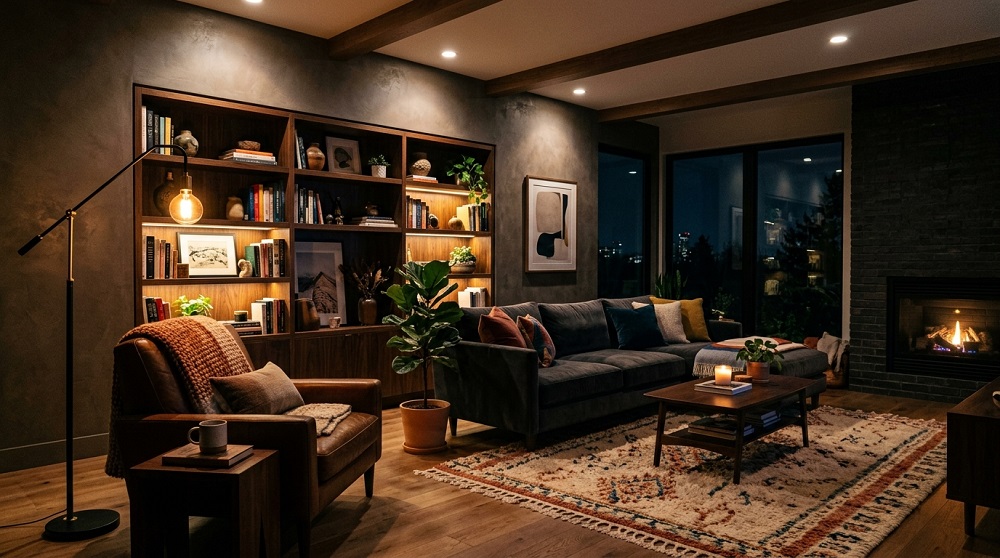
Lighting shapes a room as much as furniture or colour, yet it’s often chosen last and adjusted least. Getting it right isn’t about a single perfect fixture — it’s about layering different types of light to match how each room is actually used.
- Understand the Three Layers of Lighting
- Ambient Lighting
- Task Lighting
- Accent Lighting
- Living Rooms: Prioritise Flexibility
- Warm Tones Work Better Here
- Kitchens: Layer for Function First
- Bedrooms: Soft, Adjustable, and Layered
- Bathrooms: Bright, Shadow-Free, and Practical
- Home Offices: Reduce Eye Strain
- Match Bulb Colour Temperature to the Room’s Purpose
- Don’t Overlook Dimmers
- Light the Room, Not Just the Ceiling
Understand the Three Layers of Lighting
Most well-lit rooms combine three distinct layers rather than relying on one overhead source.
Ambient Lighting
This is the general, overall light in a room — ceiling fixtures, recessed lighting, or a central pendant. It sets the baseline brightness but rarely looks flattering or functional on its own.
Task Lighting
Focused light for specific activities — a desk lamp, under-cabinet kitchen lighting, a reading lamp beside a chair. Without it, ambient light alone often leaves detailed tasks poorly lit even in a bright room.
Accent Lighting
Used to highlight a feature — artwork, a bookshelf, architectural detail — accent lighting adds depth and warmth that flat overhead lighting can’t achieve alone.
A room with only ambient lighting tends to feel flat and clinical; combining all three creates a space that feels both functional and considered.
Living Rooms: Prioritise Flexibility
Living rooms serve multiple purposes — relaxing, reading, entertaining — so lighting needs to adjust accordingly. A dimmable ambient source paired with a few table or floor lamps at seating height gives control over mood without needing to change fixtures for different occasions.
Warm Tones Work Better Here
Warmer light (around 2700–3000K) tends to suit relaxed, social spaces better than the cooler, brighter tones suited to task-focused rooms.
Kitchens: Layer for Function First
Kitchens need strong, even task lighting above all — under-cabinet lights over counters and focused fixtures over islands or prep areas prevent shadows from your own body blocking the work surface. Ambient overhead lighting fills in the rest, and a pendant or two over an island adds both function and visual interest.
Bedrooms: Soft, Adjustable, and Layered
Bedrooms benefit from softer ambient lighting paired with dedicated task lighting at the bed — a nightstand lamp or wall-mounted reading light avoids needing to get up to adjust overhead lighting. Dimmers are particularly useful here, letting the room shift from bright and functional to low and relaxed.
Bathrooms: Bright, Shadow-Free, and Practical
Bathrooms need strong, evenly distributed light, particularly around mirrors, where shadows from a single overhead source can make grooming tasks difficult. Lighting placed on either side of a mirror, at face height, avoids the harsh shadows that a single fixture above tends to create.
Home Offices: Reduce Eye Strain
Task lighting matters most here — a well-placed desk lamp reduces eye strain during screen and paperwork use far more effectively than relying on ambient light alone. Position it to avoid glare on screens, and favour cooler, brighter tones that support focus and alertness during work hours.
Match Bulb Colour Temperature to the Room’s Purpose
Colour temperature, measured in Kelvin, affects mood as much as fixture choice. Warmer tones (2700–3000K) suit relaxed spaces like living rooms and bedrooms; cooler tones (3500–5000K) suit task-focused spaces like kitchens, bathrooms, and offices where alertness matters more than ambience.
Don’t Overlook Dimmers
Dimmer switches are one of the most cost-effective lighting upgrades available, letting a single fixture serve multiple moods and functions rather than needing separate lighting setups for different times of day.
Light the Room, Not Just the Ceiling
The most common lighting mistake is relying on a single central fixture to do all the work. Layering ambient, task, and accent lighting — matched to how each room is actually used — makes far more difference than any individual fixture choice.