Home renovation often starts long before the first tile is removed or the first contractor arrives.
For many homeowners, the process begins with ideas collected from books, magazines, photographs, saved designs, and homes they have visited. Bathroom design books in particular can be useful because they show complete spaces rather than isolated products.
A bathroom may be one of the smaller rooms in a house, but planning one well requires many decisions. Layout, lighting, storage, materials, ventilation, fixtures, colors, and daily routines all need to work together.
Looking through well-designed interiors before starting a renovation can help homeowners understand what they actually want and, just as importantly, what they do not want.
- Look Beyond the Finished Photograph
- Collect Ideas Without Copying an Entire Room
- Pay Attention to Scale
- Think About the Morning Routine
- Materials Should Be Chosen for the Room
- Lighting Deserves More Attention
- Storage Can Be Part of the Design
- Trends Are Useful, but They Should Not Control the Project
- Create a Simple Design File
- Inspiration Is Only the Starting Point
Look Beyond the Finished Photograph
The first thing most people notice in an interior design book is the finished room.
Beautiful tile, a freestanding bathtub, custom cabinetry, or unusual lighting immediately gets attention. However, the most useful lessons are often found by looking beyond those decorative elements.
Consider why the room works.
Look at where the vanity is positioned. Notice how much space exists around the shower. See where towels are stored, where lighting has been placed, and whether frequently used items can be reached easily.
A bathroom should look good, but it also needs to function several times every day.
A visually impressive design that ignores everyday routines can quickly become frustrating.
Collect Ideas Without Copying an Entire Room
Finding a bathroom you love does not mean you need to reproduce it exactly.
The room in a design book may have a completely different size, ceiling height, window position, plumbing layout, or budget.
Instead, identify individual elements that appeal to you.
You might like:
- The color combination
- The shower layout
- The style of the vanity
- The way lighting is layered
- A particular tile pattern
- Built-in storage
- The use of natural materials
- The balance between modern and traditional features
Collecting individual ideas gives you more flexibility when creating a bathroom that fits your own property.
Pay Attention to Scale
Photographs can make rooms appear larger than they really are.
Wide-angle photography, professional lighting, and careful staging can dramatically change how a bathroom looks on a page.
That is why measurements should guide renovation decisions.
A large double vanity may look impressive in a spacious primary bathroom but overwhelm a smaller room. A freestanding bathtub can become inconvenient if there is not enough clearance around it.
Before becoming attached to a specific feature, check whether the room can comfortably support it.
Good design usually leaves enough space to move naturally without making the bathroom feel empty.
Think About the Morning Routine
Design books can provide inspiration, but your routine should determine the final layout.
Imagine a typical weekday morning.
If two people regularly prepare at the same time, additional counter space or a double vanity might be valuable. If several family members share one bathroom, better storage could be more useful than a large decorative feature.
Ask practical questions.
Where will toothbrushes be kept?
Where will towels dry?
Where will cleaning supplies go?
Is there enough lighting around the mirror?
Can cabinets open without blocking another fixture?
These small details determine whether a bathroom remains enjoyable after the novelty of the renovation disappears.
Materials Should Be Chosen for the Room
Bathrooms expose materials to conditions that are different from most other rooms.
Moisture, changing temperatures, cleaning products, and frequent use all affect surfaces over time.
A material that looks beautiful in a photograph may require more maintenance than expected.
When comparing ideas from books or online galleries, research how materials perform in actual bathrooms.
Consider durability, cleaning requirements, water resistance, slip resistance, and how easily damaged sections can be repaired or replaced.
For homeowners planning professional bathroom remodeling springfield mo, these design ideas can be discussed with a remodeling team and adapted to the dimensions, layout, and practical requirements of the existing space.
The best final design is usually a combination of inspiration and real-world construction experience.
Lighting Deserves More Attention
Bathroom lighting is easy to underestimate.
A single ceiling fixture may technically illuminate the room, but it does not always provide good lighting for shaving, applying makeup, grooming, or relaxing in the evening.
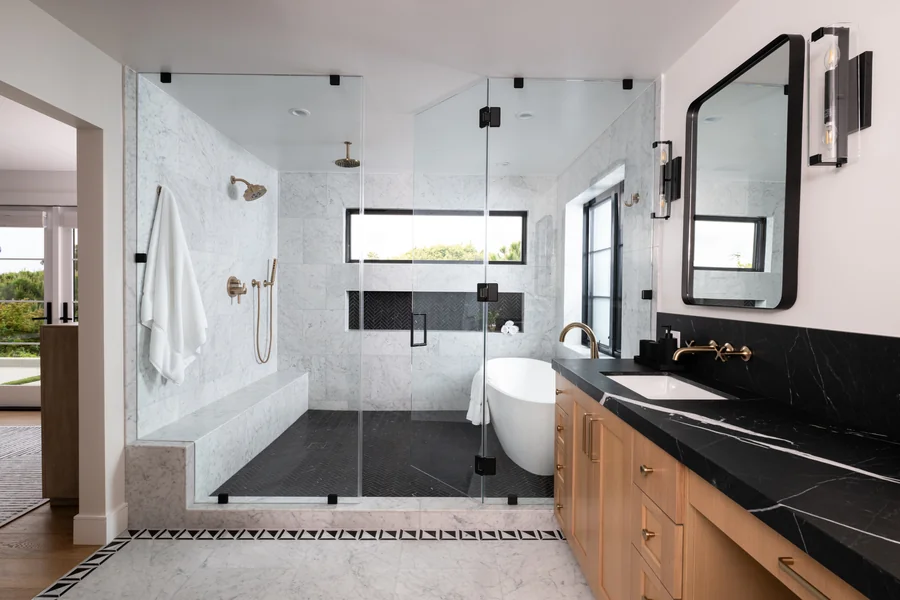
Look closely at professionally designed bathrooms and you will often notice several lighting sources.
There may be general ceiling lighting, focused lighting around the mirror, decorative fixtures, and sometimes lighting integrated into cabinetry or architectural details.
Natural light can also change the character of the room during the day.
The goal is not necessarily to install more lights. It is to put appropriate light where it is actually needed.
Storage Can Be Part of the Design
Storage is sometimes treated as something to solve after the main bathroom design is complete.
That can be a mistake.
Open shelves may look attractive in a photograph, but they also require everything on them to remain organized. Large vanities provide more hidden storage but can make a compact bathroom feel crowded.
Built-in niches, medicine cabinets, drawers, vertical cabinetry, and recessed storage can all help reduce clutter.
Think about what will actually live in the room before deciding how much storage is necessary.
A bathroom that stays organized will usually continue looking better than one where every available surface eventually becomes storage.
Trends Are Useful, but They Should Not Control the Project
Design books are valuable records of changing styles.
Looking at books from different decades makes it obvious how quickly some trends disappear.
That does not mean homeowners should avoid current styles. Trends can introduce interesting materials, colors, layouts, and technologies.
However, permanent or expensive features deserve more careful consideration.
Tile covering an entire room is harder to change than towels or wall paint. Custom cabinetry is a longer-term commitment than a mirror.
One approach is to keep major structural elements relatively adaptable while expressing more personality through items that can be changed later.
This can help a renovated bathroom age more gracefully.
Create a Simple Design File
Before meeting with a designer or contractor, organize your ideas.
This does not need to be complicated.
Save photographs or pages showing designs you like and add a short note explaining what caught your attention.
For example:
“Like the lighting, not the tile.”
“Good vanity layout.”
“Too modern overall, but like the shower.”
“Would like similar storage.”
These comments are surprisingly useful because they communicate preferences more clearly than simply saying that you want a modern, traditional, or luxurious bathroom.
It can also help prevent misunderstandings during the planning process.
Inspiration Is Only the Starting Point
The best renovation ideas rarely come from one source.
A homeowner might discover a color combination in a design book, find a practical storage solution in a hotel, notice a lighting idea in a restaurant, and then work with a professional to combine those concepts into one functional room.
That process is more useful than trying to duplicate a single photograph.
Design references help establish direction. Measurements, construction requirements, budget, and professional experience determine how that direction becomes a real room.
When the project moves from inspiration into serious planning, homeowners can also explore professionals through resources such as HireARemodeler and compare options before deciding who should handle the work.
A good bathroom renovation should still feel right years after the project is completed. Books and design references can provide the ideas, but thoughtful planning is what turns those ideas into a space that genuinely works.