- Key Takeaways
- What Should a Facility Do When It Needs High-Rate Filtration Quickly?
- Why Does a High-Rate Sand Filter Rental Request Need Technical Review?
- What Does Sandling Industrial Services’ Sand Filter Rental Include?
- Listed Equipment Specifications
- How Does Automatic Backwashing Support Continuous Filtration?
- When Is Renting a Sand Filter a Better Fit Than Buying?
- How Can Sandling Industrial Services Support a Broader Dewatering Plan?
- What Information Should Be Included in a Rental Request?
- Conclusion
Key Takeaways
- Sandling Industrial Services offers a skid-mounted, automatic-backwashing sand media filter for temporary industrial water and wastewater filtration needs.
- The listed design flow range is 504 to 756 gallons per minute, with filtration of suspended solids within approximately 15 to 20 microns.
- Successful rental planning depends on water quality, solids loading, pressure, site utilities, backwash handling, access, and discharge requirements.
- Sandling Industrial Services also supports broader solids-management needs through mechanical dewatering equipment and services.
What Should a Facility Do When It Needs High-Rate Filtration Quickly?
When a facility needs temporary filtration capacity, the priority is to define the treatment objective before selecting equipment. A high-rate sand filter rental request should specify the expected flow, water source, solids characteristics, available pressure, job-site conditions, and the required water quality after treatment.
Sandling Industrial Services provides rental equipment and industrial wastewater support for projects that may involve a planned shutdown, a temporary production increase, an emergency equipment outage, construction work, pilot testing, or other short-duration treatment needs. Renting can provide access to filtration capacity without requiring a facility to purchase and permanently install a system for a temporary application.
A high-rate sand filter is not selected by flow rate alone. Water with a higher concentration of suspended solids may require pretreatment, a reduced operating rate, or a coordinated approach combining filtration with settling, chemical treatment, sludge removal, or mechanical dewatering.
For this reason, the most useful rental discussion starts with process information rather than an equipment model number. Facilities should be ready to explain what is entering the system, what must be removed, where the treated water will go, and how the backwash water will be managed.
Why Does a High-Rate Sand Filter Rental Request Need Technical Review?
Industrial wastewater streams can differ substantially across industries, processes, pollutants, flow patterns, temperatures, chemistries, and solids concentrations. The EPA’s industrial wastewater treatment performance data illustrates why treatment technologies must be evaluated in the context of the wastewater, operating conditions, and treatment train rather than by a general performance claim alone.
Before mobilizing a rental filter, project teams should review:
- Average, peak, and intermittent flow rates.
- Total suspended solids concentration and expected particle characteristics.
- The required filtration target or discharge objective.
- Available inlet pressure, pipe connections, and pumping capacity.
- Electrical power, compressed-air availability, and remote-site limitations.
- Space for placement, lifting, access, operation, and maintenance.
- Backwash-water collection, treatment, recycling, or disposal requirements.
- Compatibility with upstream and downstream equipment.
Sandling Industrial Services states that it provides nationwide mechanical dewatering services and has more than 150 years of combined experience. That broader process perspective can be valuable when filtration is part of a larger wastewater or solids management project.
What Does Sandling Industrial Services’ Sand Filter Rental Include?
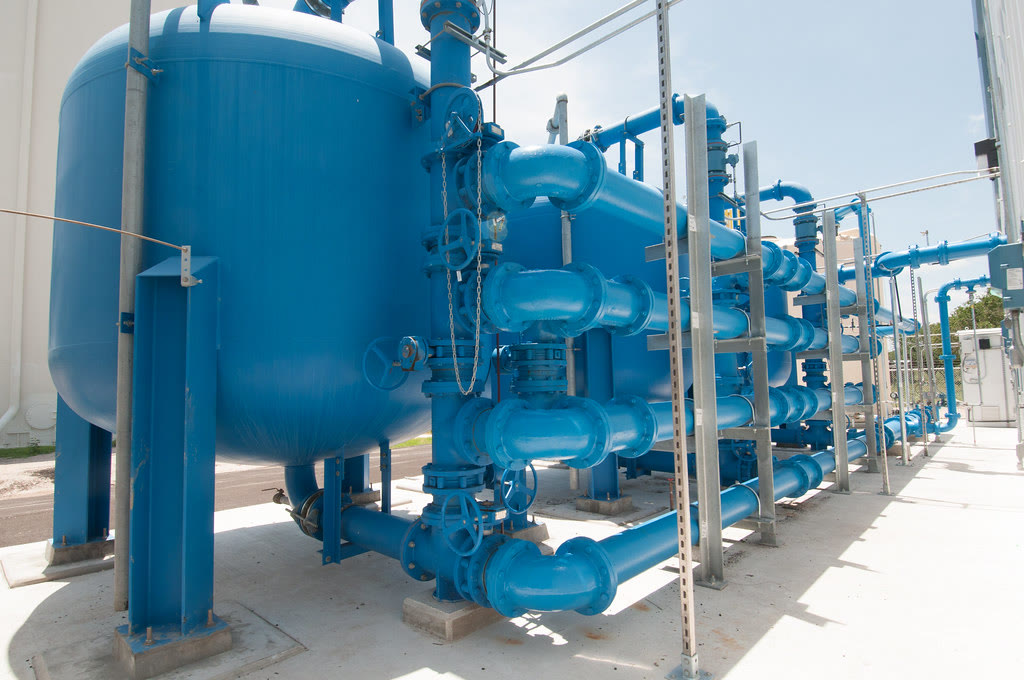
Sandling Industrial Services lists a skid-mounted, high-rate automatic-backwashing sand media filter configured with four tanks, or pods. The system is identified as a Yardney Model IL5424-4AS3 and is intended for general-purpose filtration of organic and inorganic solids.
Listed Equipment Specifications
- Design flow rate: 504-756 gallons per minute.
- Filtration range: suspended-solids removal within approximately 15 to 20 microns.
- Backwash rate: 15 gallons per minute per square foot, with a listed rate of 190 gallons per minute.
- Maximum operating pressure: 80 psi.
- Suggested minimum operating pressure: 30 psi.
- Electrical requirements: a 120-volt controller and 24-volt AC solenoids.
- Remote operation: external power or battery operation with solar-cell recharge.
- Air requirement: 2 cubic feet per minute at a minimum of 70 psig.
- Operating weight: approximately 18,000 pounds with media.
These figures are useful for initial project planning, but they do not guarantee treatment results. Actual performance depends on the incoming water, hydraulic conditions, solids loading, filter media, system controls, and the way the full process is operated.
How Does Automatic Backwashing Support Continuous Filtration?
During normal operation, water passes through the media bed and suspended solids are retained in the filter. As solids accumulate, resistance through the bed increases. Sandling Industrial Services lists a 10-psi pressure drop as the point that triggers automatic backwashing.
During the backwash cycle, inlet flow to the selected filter changes and clean filtered water from the remaining filters moves upward through that vessel. The reverse flow lifts and expands the media, allowing collected contaminants to be released and carried away in the backwash water.
Guidance on sand media filter operation similarly explains that backflushing reverses flow through a filter and uses clean water to suspend the media and remove retained contaminants. This is why backwash capacity and disposal planning are essential parts of an equipment review.
When Is Renting a Sand Filter a Better Fit Than Buying?
Rental filtration can make practical sense when treatment demand is temporary, uncertain, or tied to a defined project schedule. Common situations include emergency replacement of unavailable equipment, seasonal flow increases, planned maintenance outages, construction dewatering, pilot programs, and temporary discharge-control work.
It can also be useful when a facility wants operating data before making a capital investment. A rental period may help a project team observe flow behavior, solids loading, backwash frequency, operating pressure, and the interaction between filtration and other treatment steps.
How Can Sandling Industrial Services Support a Broader Dewatering Plan?
Sand filtration and mechanical dewatering perform related but different functions. Filtration focuses on removing suspended solids from a water stream. Mechanical dewatering focuses on separating liquid from sludge or concentrated solids, allowing the remaining material to be handled, transported, treated, or disposed of more effectively.
Sandling Industrial Services lists belt filter presses, centrifuges, and chamber filter presses as part of its mechanical dewatering capabilities. A project that begins with filtration may also require sludge handling, equipment repair or refurbishment, or additional support for solids-liquid separation.
What Information Should Be Included in a Rental Request?
- Expected average and peak flow rates.
- The source and type of water or wastewater.
- Available laboratory data, including suspended solids results where available.
- The desired filtration target, reuse objective, or discharge requirement.
- Available inlet pressure, pump information, and pipe connection details.
- Electrical power and compressed-air availability.
- Backwash-water collection and disposal arrangements.
- Project location, site-access constraints, and expected rental duration.
- Placement area, lifting needs, safety requirements, and relevant permit conditions.
Conclusion
Sandling Industrial Services offers a practical option for facilities that need temporary, high-rate sand media filtration while managing broader wastewater and solids-handling requirements. Its listed automatic-backwashing filter provides a defined starting point for projects in the 504 to 756 gallons-per-minute range, but final suitability depends on the actual waste stream and site conditions. A detailed application review helps align the rental equipment, backwash plan, and any needed dewatering support with the treatment challenge at hand.