
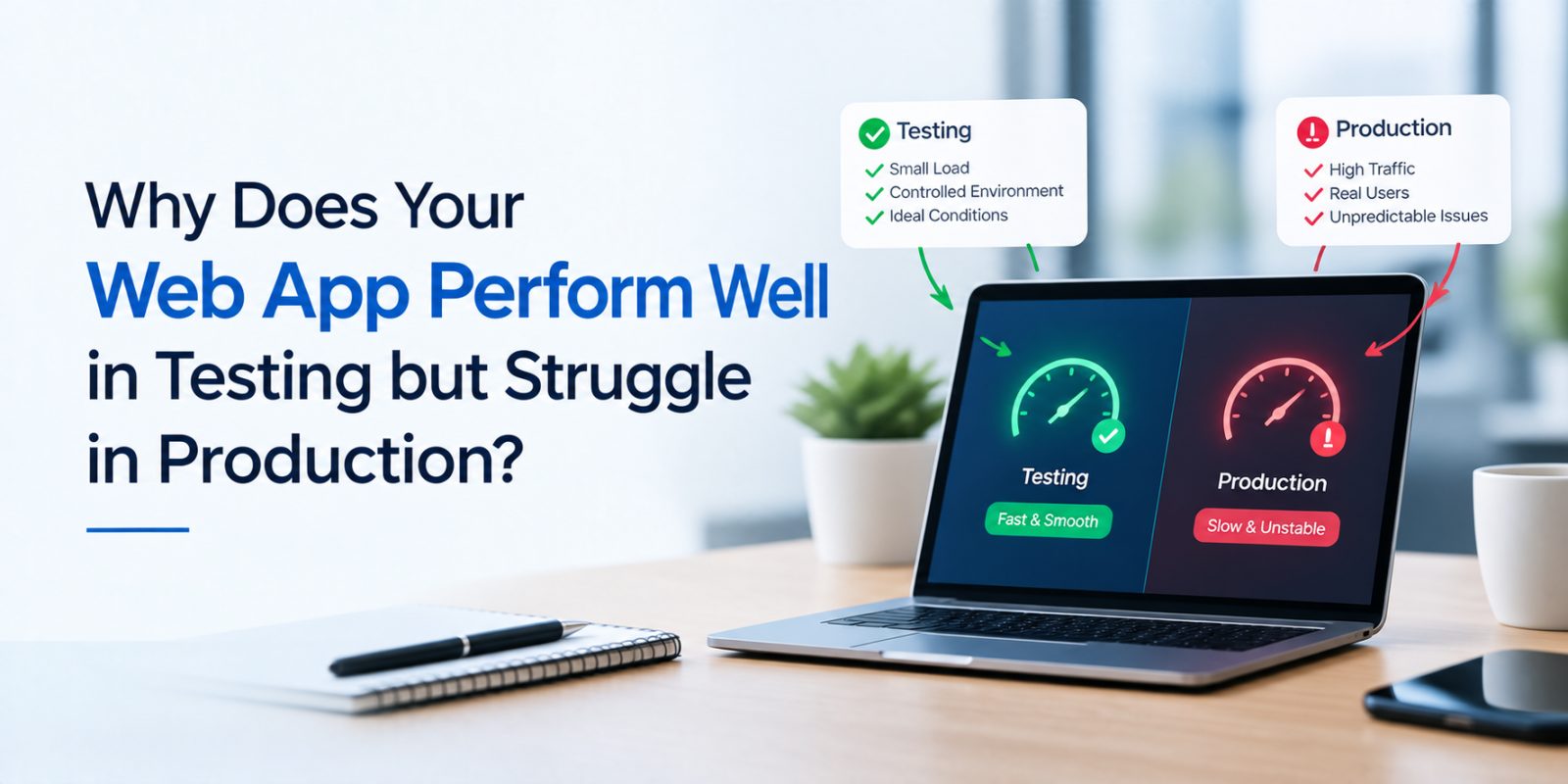
Almost every technology leader has lived through this moment. The application sails through quality assurance. Every test passes, the demo impresses the board, and the launch date gets confirmed. Then real customers arrive, and the same product that felt effortless in testing begins to stall, time out, or quietly drop orders.
The cause is rarely bad code. It is the distance between a controlled environment and the real world. Test environments are polite. They send predictable traffic, use clean data, and rarely ask the system to do ten things at once. Production is not polite. It brings traffic spikes, messy records, third party outages, and users who behave in ways nobody scripted.
That distance is where growth quietly gets capped. When a platform buckles under real usage, the symptoms show up as abandoned carts, slow support queues, and stalled onboarding, so the problem gets blamed on sales or service rather than on the system underneath. Companies that avoid this treat their software as business infrastructure from day one, which is why more of them now scope custom AI software development services around expected load and future integrations instead of around a launch date.
The encouraging part is that the testing to production gap is predictable. It follows a small number of patterns, and almost every one of them can be designed out before the first line of code is written.
What Defines an Enterprise-Grade Application
Enterprise-grade is a phrase used loosely, so it helps to define it in plain terms. It describes five qualities that only reveal themselves once real users arrive, and together they mark the line between a working prototype and serious custom web app development.
Scalability. The system absorbs ten times the traffic without being rebuilt. Think of a supermarket that can open more checkout lanes on a busy Saturday rather than one that needs a new building.
Security. Access control, encryption, and audit trails are decided at the architecture stage, not added after a compliance review flags them.
Performance. What matters is consistent response time when the system is busy, not best-case speed on an empty test server.
Reliability. Strong systems fail in small pieces. If the recommendation engine goes down, checkout still works. Weak systems take everything down together.
Integration. The application exchanges data cleanly with payments, CRM, ERP, and analytics tools, because very little value sits inside one application alone.
Key Pillars for Long-Term Growth
Modular architecture. A monolith is one large building where everything shares the same wiring, so a fault in one room can close the whole place. Microservices are more like separate units with their own utilities. Microservices are not automatically the better choice, since they add operational complexity and cost. The real goal is modularity: clear boundaries, so one part can be replaced or scaled without disturbing the rest.
Cloud-native development. Moving servers to a cloud provider is not the same as being cloud-native. A cloud-native system expands capacity when demand rises and releases it when demand falls, which turns fixed infrastructure spend into a cost that tracks actual usage.
Data-driven decision making. Teams cannot improve what they cannot see. Logging, monitoring, and usage analytics let leadership answer basic questions with evidence: where users drop off, which processes are slowest, and what breaks first under pressure.
Automation and AI readiness. AI readiness is mostly a data and plumbing question. Clean, well-structured data and documented interfaces make automation straightforward later. Scattered data across disconnected systems makes it expensive, regardless of which model is chosen.
Common Mistakes Businesses Make
Building to launch instead of building to operate. A minimum viable product is a reasonable strategy. Treating temporary shortcuts as permanent foundations is not, and the interest on that debt is paid in outages.
Postponing scalability until it hurts. Designing for growth at the start costs a little more. Retrofitting it after customers notice usually means rework, emergency spending, and reputational damage at the same time.
Choosing a tech stack for the wrong reasons. Stacks get picked because a developer is comfortable with them or because they are fashionable. The better test is practical: hiring availability, ecosystem maturity, security track record, and total cost over five years.
Best Practices for Building Future-Ready Applications
Plan before you build. Non-technical leaders can drive this conversation with simple questions. How many concurrent users must this support in three years? What happens on the busiest day of the year? Which systems must it connect to? What compliance requirements apply? Answers to these shape architecture far more than feature lists do.
Choose a partner who has operated systems, not just shipped them. Teams with production experience ask different questions during discovery, and those questions surface the risks that only appear after launch. NewAgeSysIT is one example of that approach. The company is based in New Jersey and works primarily with businesses across the United States, from early stage product teams to established enterprises modernising ageing platforms. That US focus shapes how it advises clients on architecture, compliance, and scale, and the breadth shows across its wider technology and product engineering services.
Optimise continuously. Load test with production-like data volumes. Release in stages rather than all at once. Review performance and infrastructure spend on a fixed schedule, the same way finance reviews budgets.
A Practical Example
Consider a scenario that plays out regularly across US mid-market companies. A distributor runs a customer ordering portal that performs well for two years. Volume doubles after a strong sales quarter, and page loads slow from two seconds to fifteen during business hours. The instinct is to buy a bigger server, which helps briefly and then stops helping.
The actual constraint turns out to be a reporting feature that queries the live order database directly. Separating reporting from transactions, adding a caching layer, and moving order processing to a queue restores speed at a fraction of the cost of a rebuild. Nothing about the business model changed. Removing the ceiling was an architecture decision.
Conclusion
Software that performs in testing and struggles in production is not an unlucky outcome. It is the natural result of designing for a demo instead of designing for reality.
The organisations that scale smoothly are rarely the ones that spent the most. They are the ones that asked harder questions early, chose architecture that could grow, and treated the application as infrastructure the business depends on. That decision compounds quietly for years, first in lower maintenance costs, then in faster releases, and eventually in the ability to say yes to opportunities that competitors have to decline.
If growth is on the roadmap, it is worth having an experienced engineering team review the architecture before the next expansion, rather than after the first outage.