
- Key Takeaways
- Why Replacing Missing Teeth Matters
- The Main Tooth Replacement Options
- How Dental Implants Work
- Potential Benefits
- Possible Trade-Offs
- When A Dental Bridge May Fit
- When Dentures May Be Practical
- Comparing Your Options
- What Affects Candidacy?
- Planning Treatment And Asking Questions
- Conclusion
Key Takeaways
- Implants, bridges, and dentures can all replace missing teeth, but each option uses a different type of support.
- Dental implants replace the tooth root as well as the visible tooth, while bridges and dentures replace the visible portion.
- Bridges are fixed in place and may offer a shorter treatment timeline than implants.
- Dentures are removable and can be a practical choice for replacing several teeth or a full arch.
- A dental examination is necessary to assess gum health, bite force, jawbone support, and the condition of neighboring teeth.
- Consider maintenance, repair needs, comfort, longevity, and total costs, not only the initial price.
Missing teeth can affect everyday comfort, confidence, and oral function. Whether you are missing one tooth or an entire arch, options such as dental implants, bridges, and dentures can restore the space in different ways. People considering implant supported dentures in Orlando, FL, may also want to understand how this treatment compares with traditional removable dentures and other fixed solutions. There is no single tooth replacement choice that fits every situation. The best plan depends on the number and location of missing teeth, the health of your gums and jawbone, the condition of nearby teeth, your treatment timeline, and the type of daily care you are comfortable maintaining.
Why Replacing Missing Teeth Matters
A gap in your smile can affect more than just your appearance. It may change how you chew, speak, or clean your teeth. Over time, teeth beside or opposite the gap can shift, and the bone beneath the missing tooth may gradually lose volume. The American Dental Association notes that large spaces caused by missing teeth can affect eating, speaking, tooth position, and bone support. Replacing a tooth may help preserve bite balance and make it easier to eat foods comfortably. It can also prevent a small issue from becoming a more complex restorative concern later, particularly when shifting teeth creates crowding or uneven pressure during chewing.
The Main Tooth Replacement Options
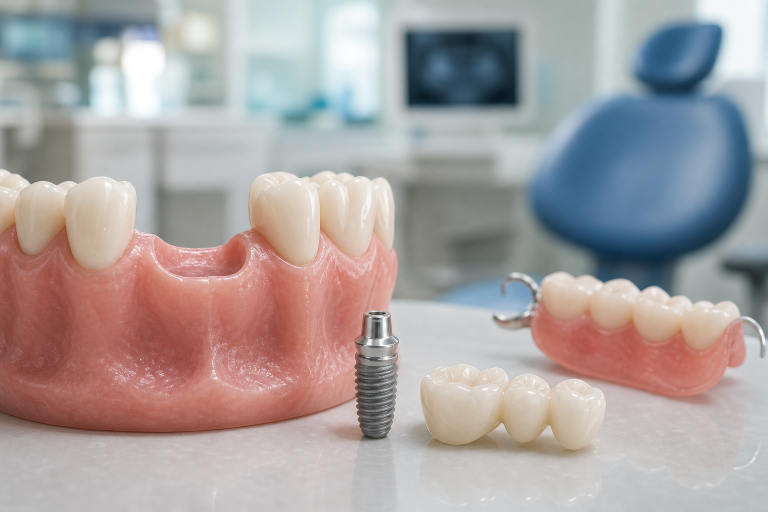
Dental implants, bridges, and dentures all serve the same broad goal, but their designs differ. An implant is placed in the jawbone and can support a crown, bridge, or denture. A bridge spans a gap by relying on neighboring teeth or implants. A denture is a removable appliance that can replace several teeth or all teeth in an upper or lower arch. The number of teeth you need to replace matters. A person missing one back tooth may have different needs from someone who has lost multiple teeth because of decay, injury, or gum disease.
How Dental Implants Work
A dental implant is a small post surgically placed in the jawbone to serve as an artificial tooth root. After healing, it can support a crown for one tooth, a bridge for several teeth, or a denture for a full arch. According to clinical guidance on dental implants, the process often includes placement, a healing period in which the bone integrates with the implant, and attachment of the final restoration.
Potential Benefits
- Provides fixed support for a replacement tooth or teeth.
- Often avoids reshaping healthy teeth next to a single-tooth gap.
- May help maintain bone in the area of the missing tooth.
- Can improve stability for dentures that otherwise move during eating or speaking.
Possible Trade-Offs
- Requires surgery and a healing period that may take several months.
- May require bone grafting, extraction, or gum treatment first.
- Usually has a higher initial cost than a traditional bridge or removable denture.
When A Dental Bridge May Fit
A dental bridge is a fixed restoration that fills a gap between teeth. With a traditional bridge, the teeth on either side of the missing tooth are prepared for crowns, which support the replacement tooth between them. Some bridges use implants rather than natural teeth for support. A bridge may be worth considering when nearby teeth already need crowns or extensive repair, when a person wants a fixed restoration without implant surgery, or when a shorter treatment timeline is important. The main consideration is that traditional bridges require reshaping the supporting teeth and require careful cleaning beneath the replacement tooth.
When Dentures May Be Practical
Dentures are removable appliances. A partial denture replaces several missing teeth while fitting around remaining natural teeth. A complete denture replaces all teeth in the upper or lower arch. They can be an efficient solution for extensive tooth loss and often have a lower starting cost than implant-based care. However, dentures may need periodic adjustments because gums and bone change over time. Some people experience movement, sore spots, or reduced confidence in chewing. Implant-supported dentures can add stability while still allowing a removable or fixed full-arch restoration, depending on the treatment design.
Comparing Your Options
- Fixed or removable: Implants and bridges are typically fixed. Traditional dentures are removable.
- Root replacement: Implants replace the missing tooth root. Bridges and conventional dentures do not.
- Impact on nearby teeth: Implants generally leave neighboring teeth unchanged. Traditional bridges often use adjacent teeth for support.
- Treatment time: Bridges and dentures may be completed more quickly. Implants commonly require surgical healing time.
- Daily care: Implants and bridges require brushing and specialized flossing or cleaning tools. Dentures require removal and cleaning each day.
- Long-term needs: All restorations may need repairs or replacement. Dentures may require relines, while implant crowns, bridges, and attachments can eventually wear or need service.
What Affects Candidacy?
A dentist will evaluate more than the missing tooth itself. Gum disease, active infection, bone height, tooth grinding, smoking, diabetes, medications, and oral hygiene habits can influence the recommended option. These factors do not always eliminate a treatment choice, but they may affect the order, timing, or complexity of care. An evaluation may include X-rays or three-dimensional imaging, a gum examination, a bite assessment, and a review of your medical history. This information helps identify whether the area needs additional care before a final restoration is placed.
Planning Treatment And Asking Questions
A useful consultation should explain the benefits and limitations of each realistic option. Ask which treatments fit your oral health, whether delaying care could create additional problems, and whether you may need gum treatment, extraction, or bone grafting first. You should also ask about the full timeline, recovery expectations, cleaning routine, repair history, and what is included in the estimate. A thoughtful choice weighs comfort, function, maintenance, long-term value, and budget. When a treatment plan is complex, seeking a second opinion can provide a helpful perspective before you decide.
Conclusion
Choosing between dental implants, bridges, and dentures depends on more than the initial price or treatment timeline. Each option offers different benefits, maintenance needs, comfort considerations, and long-term costs. Implants can provide root-like support, bridges offer a fixed alternative that may be completed sooner, and dentures can provide a practical, removable solution for multiple missing teeth. A thorough dental examination can help determine which option fits your gum health, jawbone support, bite, neighboring teeth, and overall goals. By comparing the complete treatment process, expected recovery, maintenance, repair needs, and total investment, patients can make a more informed decision and choose a tooth replacement solution that supports comfortable daily function and long-term oral health.